Welcome to the Theory of Elliptic Curves!
This series of lectures is designed for Master and PhD students, and also researchers. It aims at highlighting five central features of the theory of elliptic curves. We start with the classical concept of ellipses and some of their (quite surprising) properties, e.g., the behaviour of billiards played on them, or mechanical devices allowing to draw them. Also, osculating circles and the computation of the length of an arc on the ellipse will be discussed.
The second lecture turns to complex analysis and doubly periodic complex meromorphic functions. These are the complex analogon of real trigonometric functions, and deploy a beautiful internal structure culminating in the construction of the Weierstrass p-function p(z).
We then proceed to aspects from algebraic geometry, defining now explicitly elliptic curves as the zero-set E of a bivariate cubic polynomial in the projective plane. The pair consisting of p(z) and its derivative p'(z) will be shown to establish a diffeomorphism with the real torus. Further, a simple version of Bézout's theorem allows us to construct a magic addition on E, which thus becomes an abelian group.
This leads us to lecture four where group theoretic properties of E are discussed. Most prominently, we look at E defined over the integers or the rational numbers and describe the theorems of Nagel-Lutz and Mordell about the finite generation of E(Q).
The last lecture picks up number theoretic questions, for instance, the existence of rational points on E(Q), the theory of congruent numbers, and the notorious conjectures about the rank of an elliptic curve.
No special prerequisites will be required, but it will be good to refresh forehand the theory of holomorphic and meromorphic functions (in one variable), the basics of algebraic geometry (tangents, intersection numbers, Bézout's theorem), and the structure theorem about finitely generated abelian groups.
We will provide reading material and accompany the course by many exercises you may be tempted to solve on your own.
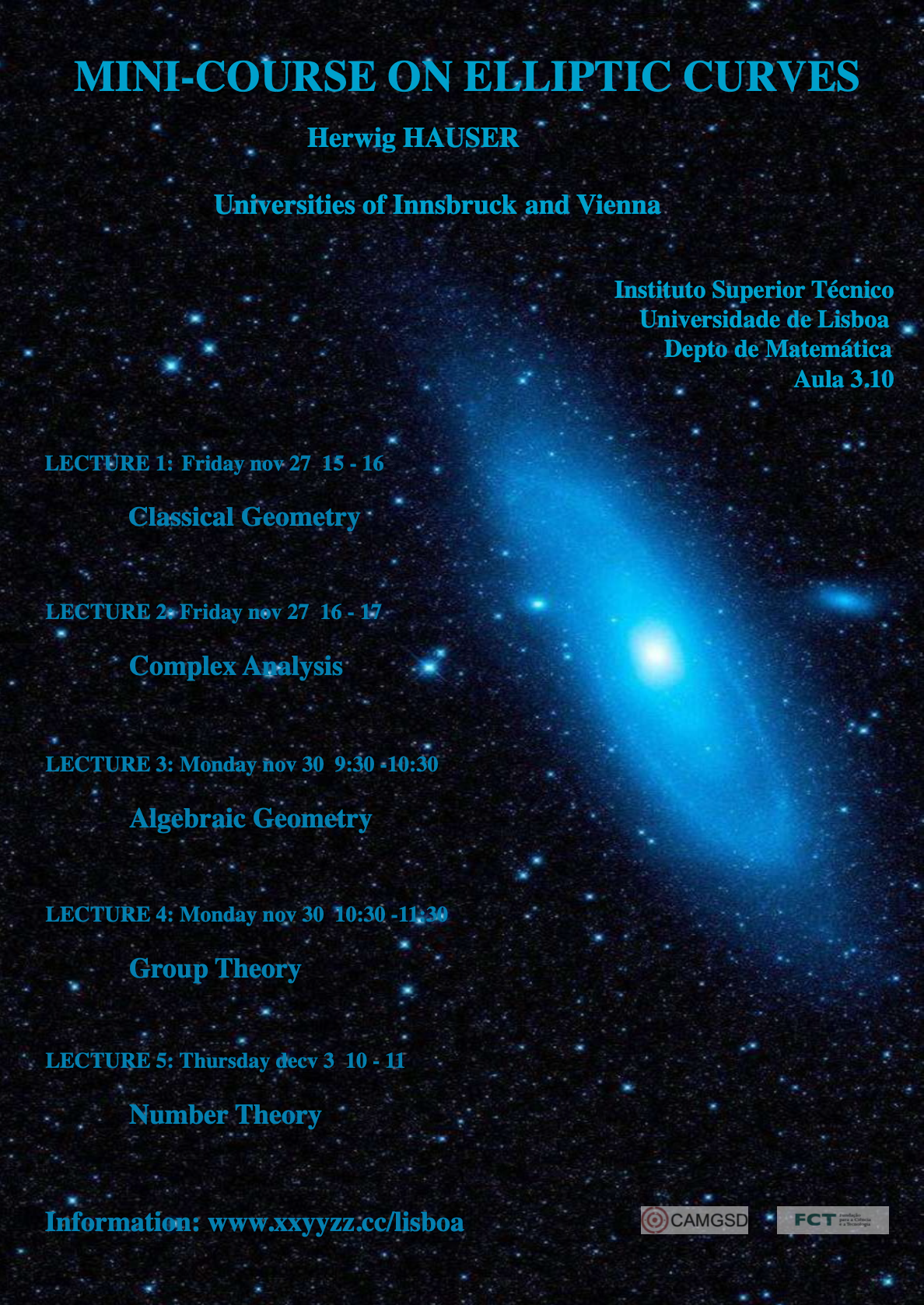
The course takes place in Instituto Superior Técnico, Faculdade de Matemática, Universidade de Lisboa 3rd floor, Room 3.10
Contact: Herwig Hauser, Faculty of Mathematics, University of Vienna,
and Institut für Mathematik, University of Innsbruck
How to define an ellipse; its foci and excentricities; the construction of osculating
circles; trajectories of billiards; Kepler's laws about planets; linkages draawing ellipses.
Lattices in C; doubly periodic meromorphic functions; Liouville's theorem; Weierstrass
p-function; poles and zeros; functional algebraic equation between p(z) and p'(z).
Cubic bivariate polynomials; normal forms; singular points; projective curves; tangents;
addition law; examples.
Associativity of group law; Mordell's theorem about finite generation; the rank of an elliptic curve; world records;
theorem of Nagel-Lutz; automorphisms; j-invariant.
Integer and rational points on elliptic curves; congruent number problem; reduction modulo primes;
applications to cryptography; modular forms; the conjecture of Birch-Swinnerton-Dyer, the ABC-conjecture.
Lecture 2: Complex Analysis, Friday, November 27, 4 - 5 pm
Lecture 3: Algebraic Geometry, Monday, November 30, 9,5 - 10,5 am
Lecture 4: Group Theory, Monday, November 30, 10,5 - 11,5 am
Lecture 5: Number Theory, Thursday, December 3, 10 - 11 am